Why Babies Get Gassy After Bottle Feeding—and How a Nipple Flange Vent Valve Helps
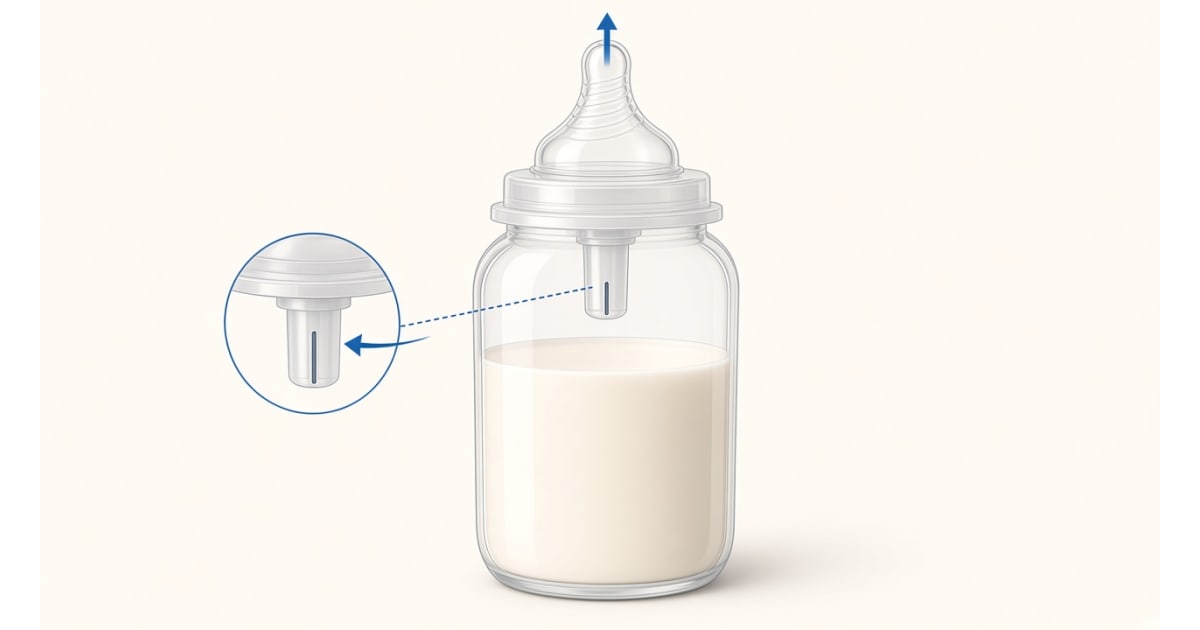
If your baby often becomes gassy or fussy after a bottle, the issue is often swallowed air—not only the formula. A true anti-colic nipple uses a short silicone vent valve on the underside of the flange, pointing down into the bottle, so air enters the bottle headspace to balance pressure instead of traveling into baby’s stomach with the milk. Many parents assume they need a new “anti-colic bottle.” In practice, the critical part is often the nipple structure: milk out the tip hole, air in through the flange vent valve. 1. The real problem: negative pressure inside the bottle When a baby sucks hard, a regular bottle can build negative pressure. The harder the suck, the more difficult milk flow becomes—and if air cannot enter properly, air mixes with milk and gets swallowed. Common signs include: Gas, fussiness, arched back Spit-up and frequent burping struggles Stop-and-start feeding Anti-colic design is less about softness alone, and more about this question: does air enter the bottle headspace to balance pressure without traveling into baby’s stomach with the milk? 2. The correct structure: flange vent valve facing down From the cutaway of a typical wide-neck anti-colic nipple: Location: underside of the silicone nipple flange Shape: a short cylindrical silicone peg with a slit Direction: pointing down into the bottle Construction: molded as one piece with the nipple What it is not: not a long tube through the milk, not a separate bottle-bottom vent core Remember this split: the tip hole delivers milk; the flange valve lets air in. Separate paths keep air in the bottle headspace—not in baby’s tummy. 3. How airflow works during feeding Two things happen at once: Milk flows out through the tip hole Air enters through the downward flange valve into the bottle headspace When pressure stays balanced, the nipple is less likely to collapse, feeding feels easier, and air stays in the bottle instead of being swallowed with milk. That is why anti-colic depends on the nipple
Why Babies Get Gassy After Bottle Feeding—and How a Nipple Flange Vent Valve Helps